“The Strongest Man Carries the Day,” Life in New Providence, 1716-1717

Excerpt from image of Capt. George Lowther and his Company at Port Mayo in the Gulf of Matique, 1734, showing pirates in a makeshift tent.

Table of Contents:

Introduction

By 1716, New Providence stood as a stronghold for pirates.  Since past Bahamian residents and governments allowed pirates to enter and use their harbor for generations, this news surprised few among people familiar with New World maritime activity.  John Graves, a former customs collector in Nassau, published a prediction in 1707 that the Bahamas would become a, “Shelter for Pyrates, if left without good Government and some Strength.”  He further predicted, “that one small Pyrat with Fifty Men that are acquainted with the Inhabitants (which too many of them are) shall and will Ruin that Place, and be assisted by the loose Inhabitants; who hitherto have never been Prosecuted to effect, for Aiding, Abetting, and Assisting the said Villains with Provision.”1  Six years later, Grave’s predictions came true.

In the past decade, a premium channel television program, a billion-dollar video game franchise, and popular press publications all helped revive public awareness and interest in the Bahamas and its pirate past.  These shows, games, and books are consistent in the manner they present the history of New Providence.  In telling the stories of the pirates, the narratives usually centered on captains, their crews, and the British officials that confronted them.  The recent portrayals of Nassau tend to follow what Hollywood and artistic mediums has done for generations.  The romanticized image of the typical pirate base set at a remote Caribbean settlement features a group of wooden post-and-beam frame buildings, built near an elegant beach, and populated with pirates gallivanting with attractive women day and night.  This common media depiction, while appealing to general audiences, is two-dimensional.  This weak caricature does not delve deep into understanding what New Providence was like in 1716-1717, when Nassau’s pirate population was at its peak. Continue reading
A Sailor’s Possessions

Excerpts from

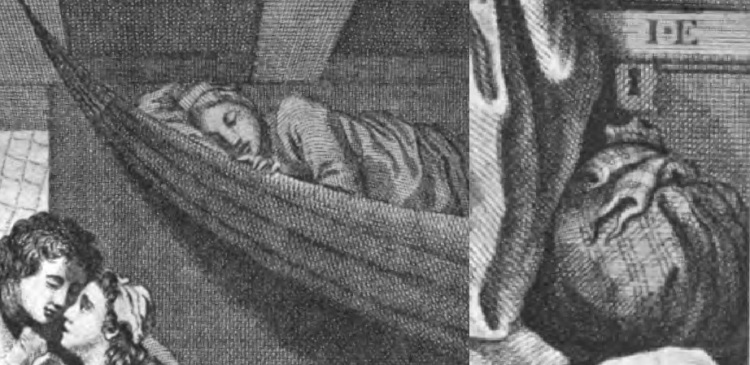
Excerpts from “The Sailor’s Parting,” by C. Mosley, 1743. The image includes depictions of a hammock, sea chest (with initials), and simple bag.

The sea chest is a common piece of material culture seen among stereotypes of pirates and sailors in the Age of Sail.  Many people imagine a variety of items locked away within these chests, from fascinating tools of the seafaring trades to treasure plundered during many adventures at sea.  In the realm of stories about pirates, Billy Bones owns the most famous sea chest of all fictional pirates.  In Robert Lewis Stevenson’s Treasure Island, originally published as a serial in Young Folks magazine from October of 1881 to January of 1882, Bones was the first mate of the pirate Captain John Flint.  The exterior of Billy’s sea chest was, “somewhat smashed and broken as by long, rough usage,” with a “B” burned to its top.  Stevenson described the contents of the sea chest in detail, including items concerning the story’s treasure, such as Bones’ account book, a bar of silver, a bag of coins, and a treasure map.  Beyond these pieces concerning the treasure, the chest contained a suit of clothes, “a quadrant, a tin canikin, several sticks of tobacco, two brace of very handsome pistols,…an old Spanish watch and some other trinkets of little value and mostly of foreign make, a pair of compasses mounted with brass, and five or six curious West Indian shells… [and] Underneath there was an old boat-cloak, whitened with sea-salt on many a harbour bar.”1  Contents such as these are typical by the standards of the modern stereotype of sailors and pirates in the Golden Age of Piracy.  When compared to the historical record, with exception to the treasure items, how accurate is Stevenson’s depiction?  What did Anglo-American sailors or pirates of the late seventeenth and early eighteenth centuries own?  Broadly speaking, some sailors of the era did own the kind of items seen in Stevenson’s stereotypical sea chest.  However, examining the historical record for traces of sailors’ possessions provides some insight into the lives of mariners in this era. Continue reading

Reflections on the Neyuheruke 300 Conference and Tuscarora Conflict

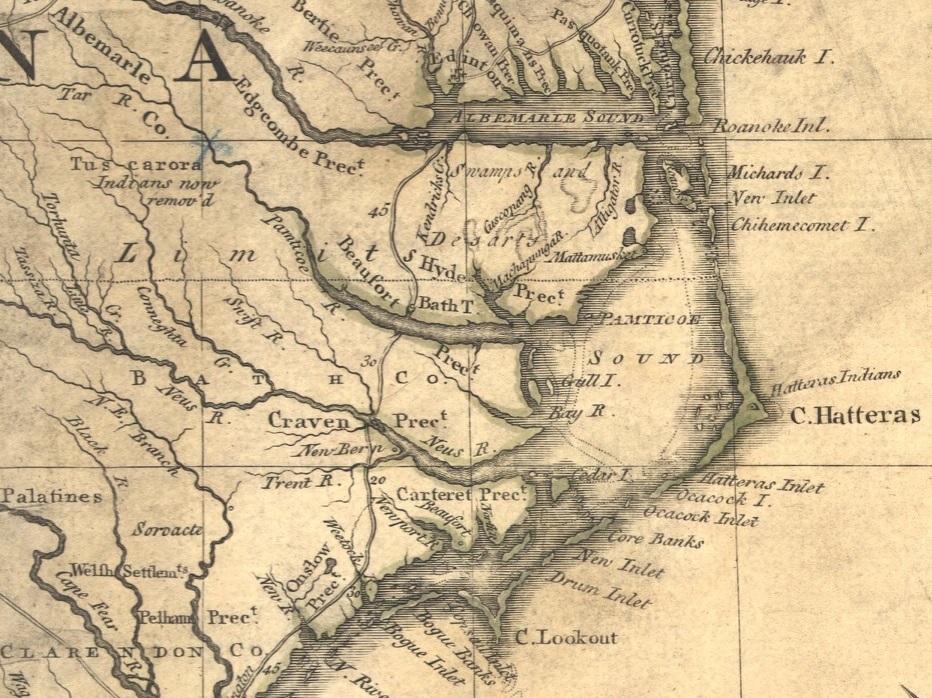
Mitchell Map, Eastern North Carolina Section, c. 1750

Mitchell Map, Eastern North Carolina Section, c. 1750

From 2012 to 2013, I participated in the recognition of the tercentenary of an historical event.  Before 2012, I knew little of the Tuscaroras, the Tuscarora conflict from 1711-1715, and the siege and battle of Neyuheruke.  The history of this event receives limited attention.  There are select groups who will know of this conflict, such as some North Carolina students, academics who study pre-American Revolutionary War colonial history or the history of the American Indian, and the Tuscaroras themselves that still live on today.  Thanks to a pair of conferences held at East Carolina University, in particular the one held in 2013, I am more aware of an event that deserves more attention in early American history.

Neyuheruke (or Neoheroka, there are several spellings) was an American Indian community located along the Contentnea Creek, near the present town of Snow Hill, North Carolina.  While it might be easier to call Neyuheruke a village or town, it does not fit the concept of a settlement with a central cluster of buildings.  There may have been a central plaza, but Neyuheruke and other Contentnea Creek communities featured scattered dwellings instead of a central group of buildings clustered close together.  During the Tuscarora conflict, Neyuheruke allied with several other Tuscarora communities against the Europeans (and their American Indian allies).  After a campaign led by Colonel Barnwell against the Tuscarora in early 1712, the people of Neyuheruke constructed a fort sometime between February and November.  In March of 1713, another expedition against the Tuscarora laid siege to this fort around March 1.  This force, under the command of Colonel Moore, consisted of 108 Europeans and 750 Cherokee, Yamassee, and other American Indian allies.  Inside the fort resided some 850 to 1,000 Tuscaroras.  After a three-week siege, the final assault occurred over a three-day battle from March 20 to the morning of March 22.  The hard-fought battle resulted in the Tuscaroras suffering between 350 to 450 deaths.  At least 400 remaining Tuscaroras became prisoners. Moore’s forces suffered 139 dead or wounded.  The Tuscarora prisoners returned with Moore’s men to South Carolina as slaves.  Many found themselves for sale in Charleston, and from there exported to various other parts of the Western Hemisphere, including Boston.  The capture of Neyuheruke’s fort marked the breaking of the opposition to the North Carolina Europeans, though smaller raids occurred until 1715.  In the long term, the conflict resulted in many of the remaining Tuscaroras traveling north to reunite with the Iroquois Confederacy and resume their status as the sixth Iroquois tribe. Continue reading